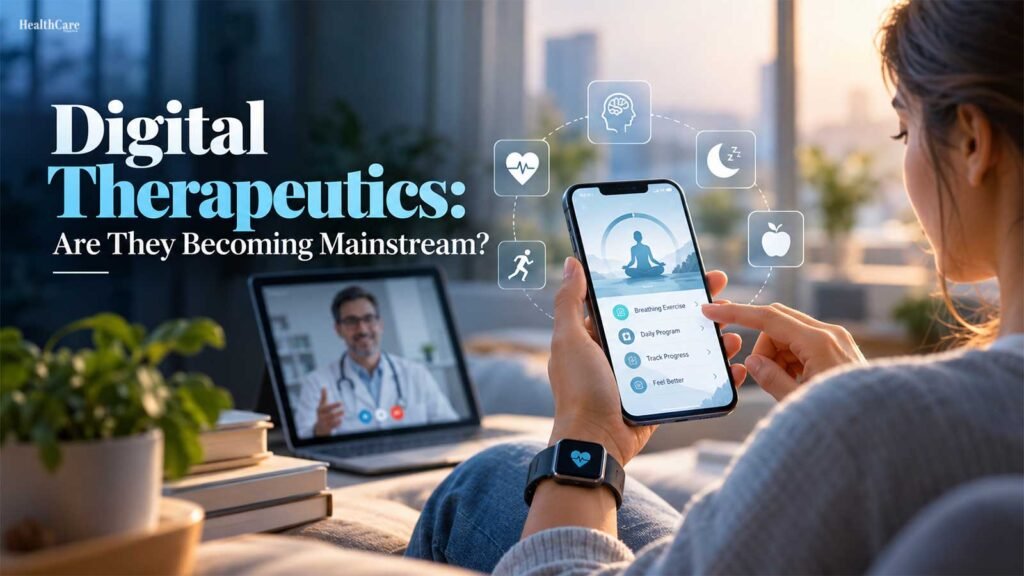
Healthcare is becoming increasingly digital. Patients can now speak with doctors through telehealth platforms, monitor their health with wearable devices, and use mobile apps to manage different aspects of their care.
Another important part of this shift is digital therapeutics (DTx).
Digital therapeutics are software-based healthcare interventions designed to help prevent, manage, or treat certain health conditions. Unlike general wellness apps that track steps or offer meditation exercises, digital therapeutics are designed around specific clinical goals and often use evidence-based approaches.
In the United States, interest in digital therapeutics has grown among healthcare providers, technology companies, insurers, employers, and patients. However, an important question remains: Are digital therapeutics becoming part of mainstream healthcare, or are they still a developing category?
The answer is somewhere in between. Digital therapeutics have made meaningful progress, but several challenges need to be addressed before they become a routine part of care for most Americans.
What Are Digital Therapeutics?
Digital therapeutics use software to deliver a structured health intervention. Depending on the product, patients may access the treatment through a smartphone, tablet, computer, or another connected device.
A digital therapeutic may help patients:
- Change unhealthy behaviors
- Follow a structured treatment program
- Manage symptoms
- Improve medication adherence
- Track progress over time
- Develop healthier daily habits
- Share relevant health information with their care team
Some products are designed to work alongside medication or traditional therapy. Others may provide an additional treatment option when appropriate.
Digital therapeutics have been explored across areas such as mental and behavioral health, substance use disorders, insomnia, diabetes, chronic disease management, and other conditions.
The key difference between digital therapeutics and ordinary health apps is their clinical purpose.
Thousands of wellness apps are available to consumers, but not every app should be considered a treatment. Digital therapeutics are generally developed with clinical evidence, defined patient outcomes, and healthcare use in mind.
Why Are Digital Therapeutics Gaining Attention?
One of the biggest reasons is simple: healthcare does not happen inside hospitals and clinics.
Patients spend most of their time at home, at work, or going about their normal lives. A traditional medical appointment provides a small window into what happens between visits.
Digital therapeutics can extend certain parts of care beyond the clinic.
For example, instead of receiving advice during an appointment and waiting several weeks for the next visit, a patient may use a digital program regularly between appointments. The software can provide exercises, educational material, reminders, progress tracking, or other forms of structured support.
This creates the possibility of more continuous care.
The growth of telehealth has also made Americans more comfortable with receiving healthcare through digital channels. Remote patient monitoring, patient portals, smartwatches, and health apps have become familiar parts of the healthcare experience.
Digital therapeutics fit naturally into this broader movement toward connected care.
Digital Therapeutics vs. Traditional Health Apps
The terms “health app” and “digital therapeutic” are sometimes used interchangeably. They do not.
A fitness app may help users count steps. A meditation app may provide relaxation exercises. A nutrition app may help people track calories.
These products can be useful, but they are generally focused on wellness.
A digital therapeutic goes further by targeting a particular medical need or clinical outcome.
Some digital therapeutics may also fall under medical device regulations in the United States, depending on what the software does and the claims being made about it.
This distinction is important for healthcare organizations.
Doctors, insurers, and health systems need confidence that a digital product is safe, clinically useful, and appropriate for the patient population it is designed to serve.
Where Are Digital Therapeutics Being Used?
Digital therapeutics have attracted interest across several areas of healthcare.
1. Mental and Behavioral Health
Mental health is one of the most promising areas for digital care.
Many Americans face challenges accessing mental health professionals because of cost, location, long waiting periods, or shortages of qualified providers.
Digital programs can help expand access to certain evidence-based techniques and structured behavioral interventions.
They are not necessarily replacements for psychologists, psychiatrists, or counselors. Instead, they may provide additional support between appointments or help certain patients access structured care when traditional options are difficult to reach.
2. Chronic Disease Management
Chronic diseases require ongoing management.
A patient with a long-term condition may need to monitor symptoms, follow medication schedules, improve diet, increase physical activity, and maintain healthy routines.
These tasks happen every day, not just during medical appointments.
Digital therapeutics can provide regular guidance and help patients stay engaged with their treatment plans.
The long-term opportunity is to combine digital interventions with remote monitoring, connected medical devices, and healthcare professionals to create more personalized care.
3. Substance Use Disorders
Digital therapeutics have also been developed to support people receiving treatment for substance use disorders.
Structured digital programs can provide behavioral exercises, education, and ongoing support as part of a broader treatment plan.
For patients who find it difficult to attend frequent in-person sessions, digital access may provide another way to stay connected to treatment.
4. Sleep Disorders
Sleep is another area where software-based interventions may have a role.
Certain digital programs use structured approaches such as cognitive behavioral therapy for insomnia to help patients understand and change behaviors that affect sleep.
Instead of simply tracking how many hours someone sleeps, these programs are designed to guide patients through an intervention over time.
Are Digital Therapeutics Replacing Doctors?
Digital therapeutics are unlikely to replace doctors.
A better way to understand their role is to see them as an additional tool within healthcare.
Software can provide reminders, education, structured exercises, data collection, and personalized prompts. But healthcare often requires judgment, physical examinations, emotional understanding, diagnosis, and decisions that depend on a patient’s complete medical situation.
Human healthcare professionals remain essential. The more realistic future is one where digital therapeutics support doctors and patients.
A physician might recommend a digital program as part of a larger care plan. The patient could use it between visits while the healthcare team reviews relevant information and adjusts treatment as needed.
In this model, technology helps extend care rather than replace it.
What Could Make Digital Therapeutics More Mainstream?
For digital therapeutics to become a routine part of American healthcare, they must fit into the systems that doctors and patients already use.
Several developments could help.
Stronger Clinical Evidence
Healthcare providers want evidence before recommending treatments.
Digital therapeutic companies therefore need to show that their products produce meaningful outcomes for appropriate patient populations.
Strong clinical studies can help build confidence among physicians, hospitals, insurers, employers, and patients.
Evidence becomes even more important as the number of digital health products continues to grow.
Easier Integration Into Clinical Workflows
Even an effective digital therapeutic can struggle if it creates extra work for healthcare professionals.
Doctors already use electronic health records, patient portals, clinical decision systems, and other digital platforms.
Adding another dashboard or separate login may create unnecessary complexity. Successful digital therapeutics will need to fit more smoothly into existing healthcare workflows.
Ideally, healthcare professionals should be able to understand when a digital therapeutic is appropriate, recommend it, and access useful patient information without adding significant administrative burden.
Better Insurance Coverage
Cost is another major issue.
If patients have to pay the full cost themselves, adoption may remain limited. Wider insurance coverage could make digital therapeutics more accessible.
However, insurers will usually want evidence that a product improves outcomes, reduces unnecessary healthcare use, or provides other measurable value.
Greater Awareness Among Doctors and Patients
Many patients still do not know what digital therapeutics are.
Some healthcare professionals may also be unfamiliar with the category or unsure about which products have sufficient evidence.
Education will therefore be important.
Patients need to understand the difference between a clinically focused digital therapeutic and a general wellness application. Healthcare professionals need clear information about evidence, safety, appropriate use, and patient eligibility.
Challenges That Could Slow Adoption
Despite their potential, digital therapeutics face important barriers.
Patient Engagement
Downloading an app is easy. Using it consistently for several weeks or months is much harder.
Digital therapeutics only provide value when patients engage with them as intended.
Developers therefore need to create products that are easy to understand and fit naturally into patients’ lives. Complicated interfaces, excessive notifications, or time-consuming daily activities may cause users to stop participating.
Privacy and Data Security
Digital healthcare can involve sensitive patient information.
Companies must take privacy and cybersecurity seriously, particularly when digital products collect behavioral, medical, or personal data.
Healthcare organizations will also want to understand where information is stored, who can access it, and how it is protected.
Trust can disappear quickly if patients feel that their health information is not being handled responsibly.
The Digital Divide
Not every American has the same access to technology.
Some patients may lack reliable internet access, modern smartphones, digital skills, or confidence using healthcare applications.
Older adults and people in underserved communities may face additional barriers.
If digital therapeutics become an important part of healthcare, companies and health systems must ensure that technology does not create another layer of inequality.
Reimbursement and Business Models
Creating a clinically tested digital therapeutic can require significant investment.
Companies need sustainable ways to fund product development, clinical research, regulatory work, cybersecurity, customer support, and ongoing software improvement.
The digital therapeutics market has already shown that clinical innovation alone does not guarantee commercial success.
Companies must demonstrate value not only to patients but also to healthcare providers, employers, insurers, and other organizations that may pay for the technology.
The Role of AI in the Future of Digital Therapeutics
Artificial intelligence could make digital therapeutics more personalized.
Instead of providing every patient with the same program, future platforms may adjust recommendations based on a person’s progress, behavior, symptoms, and other relevant information.
For example, a system could recognize when a patient is struggling to follow a treatment program and adjust the level of support.
However, AI also creates new questions.
Healthcare organizations will need to consider how recommendations are generated, whether algorithms work fairly across different patient groups, and when human review is necessary.
The goal should not simply be to add AI because it is popular. AI should be used when it makes treatment safer, more useful, or easier for patients and healthcare professionals.
What Digital Therapeutics Mean for Healthcare Leaders
For hospital executives, physicians, insurers, and other healthcare leaders, digital therapeutics represent both an opportunity and a challenge.
The opportunity is to extend care beyond traditional appointments and provide patients with more continuous support.
The challenge is deciding which technologies actually work.
Healthcare organizations should avoid adopting digital products simply because they appear innovative. Leaders should ask practical questions:
- What clinical evidence supports the product?
- Which patients are most likely to benefit?
- How does it fit into the existing care pathway?
- Will physicians actually use or recommend it?
- Is patient data protected?
- How will success be measured?
- Who will pay for the treatment?
- Will patients continue using it over time?
These questions can help healthcare organizations separate meaningful clinical tools from products that offer attractive technology but limited real-world value.
So, Are Digital Therapeutics Becoming Mainstream?
Digital therapeutics are moving closer to mainstream healthcare, but the transition is not complete.
The idea of using software as part of treatment is no longer unusual. Patients are increasingly comfortable with digital healthcare, providers are exploring new ways to deliver care outside hospitals, and healthcare organizations are paying greater attention to software-based interventions.
However, mainstream adoption requires more than innovative technology.
Digital therapeutics need strong clinical evidence, practical reimbursement models, secure data systems, easy integration with healthcare workflows, and experiences that patients will actually use.
The companies that solve these challenges will have a much better chance of becoming part of everyday healthcare.
Conclusion
Digital therapeutics represent an important shift in how healthcare can be delivered.
Instead of limiting treatment to a doctor’s office or hospital, software can provide structured support wherever patients are. This could be particularly valuable for chronic disease management, behavioral health, sleep disorders, and other conditions that require continuous patient participation.
But digital therapeutics should not be viewed as replacements for healthcare professionals.
Their greatest potential may come from combining digital tools with traditional medical care. Doctors provide clinical judgment and human understanding, while digital platforms can help patients stay engaged between appointments.
As healthcare becomes more connected, the question may gradually change from “Are digital therapeutics becoming mainstream?” to “Where do digital therapeutics provide enough clinical value to become a standard part of care?”
For the U.S. healthcare industry, answering that question will depend on evidence, accessibility, reimbursement, patient trust, and measurable outcomes.