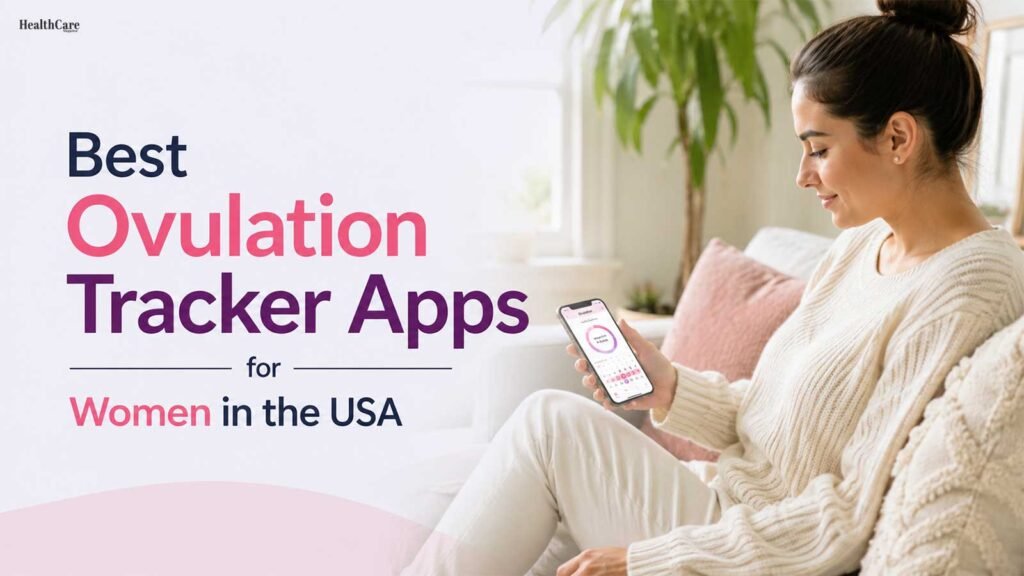
Ovulation tracker apps can help women understand their menstrual cycles, estimate fertile days, record symptoms, and organize information when trying to conceive. Some apps rely mainly on period dates, while others allow users to track basal body temperature, cervical mucus, luteinizing hormone test results, and other fertility signs.
These tools can be useful, but they have important limits. An app estimates ovulation using your period dates and previous cycle patterns. The predicted date may not always be accurate.
According to the American Society for Reproductive Medicine, fertile days can change from one cycle to another, even in women with regular periods. Therefore, an app’s estimated ovulation date should be treated as guidance rather than a guarantee.
The best ovulation tracker depends on a woman’s goal. Some women may need a simple period calendar, while others may want to record ovulation test results or body temperature when trying to become pregnant.
Here are several well-known ovulation tracker apps available to women in the United States.
1. Clue
Clue is a menstrual cycle and reproductive health tracking app. Users can record their periods, cycle symptoms, pain, mood, cervical fluid, sexual activity, and other health information.
The standard cycle-tracking features provide period and fertile-window estimates based on recorded data. Clue also offers a separate Clue Conceive mode for users who are trying to become pregnant. This mode provides fertility estimates and information intended to support conception planning.
Clue may be suitable for women who want:
- A clean and simple cycle-tracking experience
- Period and fertile-window estimates
- Detailed symptom tracking
- Educational information about reproductive health
- A record of cycle patterns that can be discussed with a doctor
Clue provides an estimated fertile window, which may not always match the actual ovulation date. That distinction matters because predicted fertile days can change as new cycle information is added.
Women with irregular periods, polycystic ovary syndrome, recent hormonal birth control use, or changing cycles may find that calendar-based estimates are less reliable. In these situations, recorded patterns can still be useful, but medical guidance or additional tracking methods may be needed.
2. Flo
Flo is one of the most widely recognized period and ovulation tracking apps. It allows users to record period dates, cycle symptoms, basal body temperature, sexual activity, and other details.
The app offers a Getting Pregnant mode that estimates fertile days and provides educational content related to conception. Users can also generate a cycle health report to share with a healthcare professional. Basic period and ovulation predictions are available without a paid subscription, while additional insights and features may require a premium version.
Flo may be helpful for women who want:
- Period and ovulation estimates in one app
- Daily cycle and fertility insights
- Basal body temperature tracking
- Symptom records and cycle reports
- A pregnancy-tracking option after conception
- Educational content and community features
Flo’s Anonymous Mode allows users to track their health without linking the information to personal details such as their name or email address. Even with privacy features, users should review the current privacy policy and app settings before entering sensitive reproductive health data.
Flo can help users recognize patterns, but its ovulation dates remain predictions. Women should avoid treating an estimated date as proof that ovulation has taken place.
3. Premom
Premom is designed for women who want to combine app-based cycle tracking with ovulation predictor kits. The app works with Easy@Home ovulation test strips and also allows users to record other fertility details.
Ovulation predictor kits detect a rise in luteinizing hormone, commonly called the LH surge. This hormone level usually rises before ovulation. Tracking the change may help women identify their fertile days more accurately.
The Premom app allows users to upload images of compatible test strips and track changes in the test results. It also supports basal body temperature, period information, symptoms, and pregnancy test records.
Premom may be suitable for women who want:
- Ovulation test-strip scanning and result organization
- LH surge tracking
- Basal body temperature charts
- Cycle and symptom records
- More detailed information while trying to conceive
Premom estimates a woman’s fertile days. The actual ovulation date may be different.
An LH surge suggests that ovulation may be approaching, but it does not always confirm that an egg was released. This is particularly relevant for women with certain hormonal conditions, including PCOS, who may experience more than one LH rise during a cycle.
4. Fertility Friend
Fertility Friend helps women track their menstrual cycles and fertile days. It has been available for many years and focuses on interpreting several types of cycle information.
Users can record basal body temperature, cervical mucus, ovulation test results, menstrual bleeding, symptoms, and intercourse timing. The app creates fertility charts and uses the recorded signs to estimate the fertile window and likely ovulation timing.
Fertility Friend may be useful for women who want:
- Detailed basal body temperature charts
- Multiple fertility signs in one place
- Custom data fields and graphs
- Ovulation pattern analysis
- Educational material about fertility charting
This platform may require more daily input than a basic period tracker. It is often better suited to users who are comfortable learning how different fertility signs work together.
Basal body temperature generally rises after ovulation because of hormonal changes. Therefore, temperature tracking can support retrospective identification of ovulation, but it may be less useful for predicting the fertile window in real time when used alone.
Illness, poor sleep, alcohol, travel, or checking at different times can change body temperature readings. Consistent tracking is important for producing a chart that is easier to interpret.
5. Natural Cycles
Natural Cycles uses temperature data and menstrual cycle information to estimate daily fertility status. It offers different modes, including options for preventing pregnancy and planning a pregnancy.
The platform can work with a basal thermometer or certain compatible wearable devices. Its Plan Pregnancy mode is intended to help users identify fertile days when trying to conceive.
Natural Cycles may be suitable for women who want:
- Temperature-based fertility tracking
- A structured daily fertility status
- Compatible wearable integrations
- Pregnancy-planning and cycle-tracking modes
- A regulated option that also has an FDA-cleared birth-control mode
The FDA has cleared Natural Cycles for use as birth control. However, users must follow the instructions carefully because its fertility predictions may not always be accurate.
Women using its birth-control mode must follow the instructions carefully. Natural Cycles does not protect against sexually transmitted infections. Anyone considering an app for pregnancy prevention should understand the difference between typical use and correct use and discuss contraceptive options with a qualified healthcare professional.
6. Ovia Fertility
Ovia Fertility is a cycle and fertility tracking app that allows users to record period dates, symptoms, cervical fluid, basal body temperature, ovulation test results, medications, and other health information.
The app provides fertile-window estimates and daily fertility information based on the data entered. It may suit women who want to track different fertility signs in one place.
Ovia Fertility may be worth considering for:
- Period and fertile-window tracking
- Recording ovulation test results
- Tracking temperature and cervical fluid
- Daily fertility information
- Moving from fertility tracking to pregnancy support
Some employers and health plans offer access to Ovia Health services as a benefit. Users should check how they obtained access, what information is collected, and whether any data may be shared with an employer-sponsored program. Health information should be reviewed carefully before it is entered into any app.
How Ovulation Tracker Apps Make Predictions
Many basic apps begin with the first day of a period and the average cycle length. They use this information to estimate when the next period and fertile window may occur.
This approach can be convenient, but cycles do not always follow the same schedule. Stress, illness, travel, hormonal changes, breastfeeding, perimenopause, weight changes, and medical conditions can affect timing.
More detailed apps may also use:
- Basal body temperature
- Cervical mucus changes
- LH test results
- Previous cycle lengths
- Menstrual symptoms
- Data from compatible wearable devices
Would entering more data make an app completely accurate? No. Additional information may help reveal personal patterns, but no consumer app can guarantee the exact day of ovulation or conception.
Women should follow the instructions for any thermometer, wearable device, or ovulation test kit they use. Incorrect testing times, inconsistent measurements, diluted urine samples, and missed entries may affect the results.
What to Consider When Choosing an App
A useful app should match the user’s reason for tracking. Before downloading one, consider the following areas.
Tracking Method
Women who only want general cycle awareness may be comfortable with calendar estimates. Those actively trying to conceive may prefer an app that records LH tests, cervical mucus, or temperature.
Ease of Use
An app should make daily recording manageable. A platform with many features may feel overwhelming if the user only wants a simple calendar. At the same time, a very basic tool may not provide enough detail for someone charting several fertility signs.
Cost
Many apps have free versions, paid subscriptions, or optional premium features. Prices and included services can change. Review the current subscription terms, renewal process, and cancellation policy before paying.
Privacy
Menstrual and fertility information is highly personal. Check what information the app collects, who can access it, and how you can delete your account and saved data.
Phone privacy matters too. A strong password, device lock, careful notification settings, and secure account access can help prevent unwanted exposure.
Intended Use
An ovulation tracking app used for conception planning is not automatically suitable for birth control. Most period trackers should not be used alone to prevent pregnancy. Users seeking contraception should choose an appropriate method with guidance from a healthcare professional.
When to Speak With a Healthcare Professional
An app can organize health information, but it cannot diagnose infertility, PCOS, endometriosis, thyroid disease, or another reproductive health condition.
Women should consider speaking with an OB-GYN or another qualified professional if they have very irregular or absent periods, unusually heavy bleeding, severe pelvic pain, or other concerning symptoms.
According to the American Society for Reproductive Medicine, an infertility evaluation is generally appropriate after 12 months of regular unprotected intercourse when the woman is under 35. Evaluation is commonly recommended after six months for women aged 35 or older. Earlier assessment may be appropriate when there is a known medical concern or another factor affecting fertility.
Choosing the Right Ovulation Tracker
Clue and Flo can help women track their cycles and estimated fertile days. Premom also allows users to record and review their ovulation test results. Fertility Friend offers detailed charting, while Natural Cycles provides temperature-based tracking and a separate FDA-cleared birth-control mode. Ovia Fertility combines several fertility signs within a broad tracking system.
No app can guarantee pregnancy or predict the exact day of ovulation. The most useful tracker is one that matches a woman’s needs, explains its limitations, protects sensitive information, and helps her have better conversations with her healthcare provider.