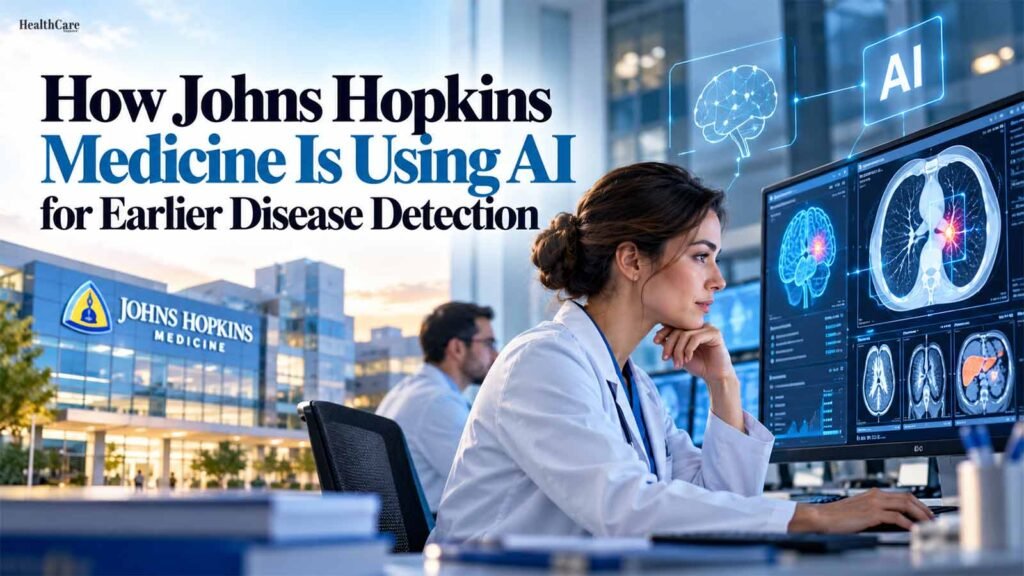
Artificial intelligence is becoming an important part of modern healthcare, but some of its most promising uses are not about replacing doctors or automating entire hospitals.
Instead, AI may help healthcare professionals answer a much simpler question:
Can we identify a serious health problem earlier?
At Johns Hopkins Medicine and across Johns Hopkins research teams, scientists, engineers, and physicians are exploring how artificial intelligence can recognize warning signs that may be difficult for humans to see.
Their work covers several major areas, including sepsis, cancer, cardiovascular disease, and medical imaging.
In some cases, AI analyzes information already available in a patient’s electronic health record. Researchers are also using AI to analyze CT scans, MRI images, blood samples, and large amounts of medical data to identify signs of disease.
The goal is not to remove physicians from the decision-making process. It is to give them better information sooner.
Here is how Johns Hopkins is using AI and advanced data analysis to help detect diseases earlier and support better patient care.
Why Earlier Detection Matters
Timing can make an enormous difference in healthcare.
Cancer identified before it spreads may be easier to treat. Sepsis detected before a patient becomes critically ill may give clinicians more time to intervene. Identifying a patient at high risk of sudden cardiac arrest could allow physicians to consider preventive treatment.
The problem is that early warning signs are not always obvious.
A patient’s medical record may contain thousands of data points. A CT scan can contain hundreds of images. Blood tests may reveal subtle changes that are difficult to interpret without considering other information.
Artificial intelligence can process large amounts of data quickly and identify patterns that might otherwise be overlooked.
That makes early detection one of the most promising areas for healthcare AI.
AI and the Early Detection of Sepsis
One of Johns Hopkins’ best-known examples of AI-assisted disease detection involves sepsis.
Sepsis occurs when the body’s response to an infection becomes dangerous and can lead to tissue damage, organ failure, and death.
The condition can progress rapidly, making early treatment extremely important.
But identifying sepsis can be difficult.
Symptoms such as fever, confusion, rapid breathing, and changes in heart rate can also appear in many other medical conditions.
Researchers led by Johns Hopkins professor Suchi Saria developed the Targeted Real-Time Early Warning System (TREWS) to address this challenge.
The system uses machine learning to analyze information from electronic health records and identify patients who may be developing sepsis.
The technology analyzes a patient’s medical history, vital signs, and laboratory results together to identify early warning signs of sepsis.
When the system identifies a patient who may be at risk, it can alert the healthcare team.
This allows clinicians to review the patient and determine whether further action is needed.
What Johns Hopkins Learned from TREWS
The sepsis project is important because it moved beyond testing AI on historical data.
Researchers studied the system in real clinical settings.
A Johns Hopkins-led study published in 2022 evaluated the use of the AI system across five hospitals. More than 4,000 clinicians used it while caring for hundreds of thousands of patients.
According to Johns Hopkins, the system detected many severe sepsis cases significantly earlier than traditional methods.
The research demonstrated an important point about healthcare AI.
A successful algorithm cannot simply be accurate in a laboratory. It also needs to fit into the way doctors and nurses actually work.
If an AI system creates too many unnecessary alerts, healthcare professionals may start ignoring them. This problem is known as alert fatigue.
The Johns Hopkins approach therefore focused not only on identifying risk but also on making alerts useful enough for clinicians to act on them.
The technology developed through this research has since been commercialized through Bayesian Health.
In May 2026, Johns Hopkins announced that the FDA had authorized the company’s sepsis early-warning technology. Johns Hopkins reported that the platform can identify sepsis hours earlier and has been associated with a meaningful reduction in mortality in real-world use.
The development shows how academic AI research can eventually become a practical clinical tool.
Using AI to Find Cancer Earlier
Cancer is another major focus of artificial intelligence research at Johns Hopkins.
Earlier cancer detection can make a major difference because many cancers become more difficult to treat after they spread.
One promising area is liquid biopsy.
Instead of relying only on a traditional tissue biopsy, researchers can examine blood for tiny amounts of genetic material released by tumors.
The challenge is finding those signals when cancer is still at a very early stage.
Johns Hopkins researchers are using advanced computational approaches, including AI, to improve the reliability of this type of analysis.
In 2025, Johns Hopkins researchers reported work involving a method called MIGHT, short for Multidimensional Informed Generalized Hypothesis Testing.
The approach aims to make AI more reliable when supporting important medical decisions. Researchers demonstrated its potential in liquid biopsy applications aimed at distinguishing cancer signals from other biological changes.
This matters because an early cancer test requires more than sensitivity alone. It must also avoid incorrectly telling healthy people that they may have cancer.
Could Cancer Be Detected Years Earlier?
Another Johns Hopkins-led study produced a particularly interesting finding.
Researchers examined blood samples that had been collected years before some participants were diagnosed with cancer.
They found that tumor-derived genetic material could be detected in some blood samples more than three years before the individuals received their cancer diagnoses.
The study involved a relatively small number of participants, so the findings should not be interpreted as evidence that a blood test can already detect every cancer three years in advance.
But the research demonstrates what may eventually become possible.
If scientists can reliably detect cancer-related signals years before symptoms appear, physicians could potentially have a much larger window for additional testing and intervention.
Johns Hopkins researchers continue to explore how sensitive sequencing, data analysis, and artificial intelligence can improve early detection of multiple cancers.
Building an AI Map of the Abdomen
Artificial intelligence is also changing medical imaging.
CT scans contain enormous amounts of information, but teaching AI systems to understand those images requires high-quality training data.
Johns Hopkins researchers have been working to solve this problem through a project called AbdomenAtlas.
Researchers at Johns Hopkins created a large dataset containing more than 45,000 three-dimensional CT scans from 145 hospitals worldwide.
The dataset includes annotations covering 142 anatomical structures.
Why is this important?
Before an AI system can reliably identify an abnormality, it needs to understand what normal anatomy looks like.
By creating a detailed map of abdominal organs and structures, researchers can train AI models to recognize important patterns more accurately.
The long-term goal is to help radiologists identify tumors and other diseases faster and more consistently.
AI could potentially analyze CT scans and direct a radiologist’s attention toward suspicious areas.
The radiologist would still make the medical interpretation, but AI could help determine the review process.
AI and Earlier Cardiovascular Risk Detection
Johns Hopkins researchers are also applying artificial intelligence to cardiovascular disease.
One area of research involves predicting sudden cardiac death.
Sudden cardiac arrest can occur when the heart unexpectedly stops pumping blood effectively. Identifying which patients are at greatest risk remains difficult.
Researchers at Johns Hopkins developed an AI system called MAARS, or Multimodal AI for Arrhythmia Risk Stratification.
The approach combines cardiac MRI data with other medical information to estimate a patient’s risk.
MRI scans can reveal scar tissue and other changes in the heart that may be associated with dangerous heart rhythms.
AI can analyze patterns within these images that may be difficult to capture through traditional approaches alone.
Johns Hopkins researchers reported in 2025 that the system showed promise in identifying high-risk patients with hypertrophic cardiomyopathy.
This is important because better risk prediction could eventually help physicians determine which patients may benefit most from preventive treatments or closer monitoring.
However, MAARS should currently be understood as a research development rather than a routine diagnostic tool available to every patient.
AI Can Find Patterns Humans May Miss
The common idea connecting these projects is pattern recognition.
Doctors are already trained to recognize medical patterns.
A radiologist looks for abnormalities in medical images. A cardiologist looks at the structure and function of the heart. An oncologist evaluates laboratory findings and cancer-related information.
AI adds another layer.
Machine-learning systems can analyze enormous datasets and identify statistical relationships that may not be obvious to humans.
For example, a physician may evaluate a patient’s current blood pressure, laboratory results, and symptoms.
An AI system could potentially compare those findings with thousands of other variables and patterns learned from large patient populations.
This does not automatically make the AI correct. Instead, it provides another source of information that healthcare professionals can consider.
Johns Hopkins and the Cancer AI Alliance
Johns Hopkins is also expanding its AI cancer research through collaboration.
The Johns Hopkins Kimmel Cancer Center and Whiting School of Engineering are participating in the Cancer AI Alliance, alongside other major U.S. cancer centers.
The initiative brings together researchers and large amounts of cancer data to develop new artificial intelligence approaches.
One goal is to use AI to understand individual cancers better and improve detection, prediction, and treatment.
Cancer is particularly well-suited to this type of research because each patient’s disease can differ.
Two people may have cancers in the same organ but have very different genetic changes, treatment responses, and outcomes.
AI could help researchers analyze these differences at a scale that would be extremely difficult to achieve with traditional methods alone.
AI Is Not Replacing Physicians
When discussing healthcare AI, it is easy to imagine a future where algorithms diagnose patients without doctors.
That is not the approach Johns Hopkins describes for its clinical AI work.
Instead, AI is generally being developed as a tool to augment and support medical experts.
Consider the sepsis example.
The algorithm can identify a pattern suggesting that a patient may be developing sepsis. But a healthcare professional still needs to evaluate the patient, understand the clinical situation, and decide on appropriate treatment.
The same principle applies to cancer and medical imaging.
AI may identify something suspicious on a scan, but physicians need to determine what that finding means for the individual patient. Human judgment remains essential.
Why Healthcare AI Needs Guardrails
Earlier detection is valuable only if the technology providing the warning is reliable.
A system that misses too many cases could give false reassurance.
A system that produces too many false alarms could lead to unnecessary tests, anxiety, higher healthcare costs, and alert fatigue among medical professionals.
AI systems can also perform differently across patient populations.
If an algorithm is trained mostly on data from one group of patients, it may not perform equally well for everyone.
Healthcare organizations therefore need to evaluate:
- Accuracy
- False-positive rates
- False-negative rates
- Performance across different patient groups
- Patient privacy
- Cybersecurity
- Clinical usefulness
- Integration with medical workflows
- Human oversight
Johns Hopkins has emphasized the importance of using AI with appropriate guardrails and maintaining physician judgment in patient care.
From Reactive Healthcare to Predictive Healthcare
The larger opportunity behind these projects is a shift from reactive healthcare to predictive healthcare.
Traditional medicine often begins after a patient develops symptoms.
A person feels sick, visits a doctor, receives tests, and is eventually diagnosed. AI could help move part of healthcare earlier in that timeline.
Instead of waiting for severe sepsis symptoms, an algorithm could detect warning signs from changing patient data.
Instead of waiting until cancer produces symptoms, researchers hope blood-based testing could identify molecular signals much earlier.
Instead of waiting for a serious cardiac event, AI could help identify which patients have the highest risk.
This does not mean every disease will eventually be predicted. But even moving diagnosis forward by hours, days, months, or years could make an important difference for certain conditions.
What This Means for U.S. Healthcare Leaders
Johns Hopkins’ work provides several lessons for hospital executives and other healthcare leaders considering AI.
First, technology should solve a clear clinical problem.
The goal should not be to “use AI.” The goal should be to detect sepsis earlier, improve cancer screening, identify high-risk cardiac patients, or make medical imaging more useful.
Second, AI needs to fit into clinical workflows.
Even an accurate algorithm will provide limited value if doctors cannot easily use its information.
Third, hospitals need to measure real outcomes.
Did the technology improve detection? Did patients receive treatment sooner? Did it reduce unnecessary testing? Did it improve outcomes?
These questions matter more than the technical sophistication of the algorithm.
The Future of Earlier Disease Detection
Artificial intelligence is likely to become increasingly important in early disease detection.
Healthcare now generates large amounts of data from electronic health records, medical imaging, genetic testing, laboratory results, wearable devices, and other sources.
No individual physician can manually analyze every possible connection within that data.
AI can help.
Future systems may continuously evaluate different types of information and alert healthcare professionals when a patient’s risk begins to change.
Cancer may be identified through subtle signals in blood. Cardiovascular risk may be estimated using medical imaging and health records. Hospital systems may recognize signs of dangerous infections before patients become critically ill.
However, moving from promising research to everyday medical care requires careful clinical validation, regulatory oversight, strong privacy protections, and evidence that the technology genuinely benefits patients.
Conclusion
Johns Hopkins Medicine and Johns Hopkins researchers are demonstrating how artificial intelligence could change one of the most important parts of healthcare: the timing of disease detection.
The work already spans several areas.
AI-assisted systems have helped clinicians identify sepsis earlier. Researchers are exploring blood-based methods that could reveal cancer signals years before diagnosis. Large imaging datasets such as AbdomenAtlas are helping scientists develop better tools for detecting tumors and other abnormalities. AI models are also being studied to identify patients at greater risk of sudden cardiac death.
These developments point to a future in which doctors may have more information before a patient’s condition becomes severe.
But AI alone will not create better healthcare.
The greatest value will come from combining the speed and pattern-recognition abilities of artificial intelligence with the experience, judgment, and human understanding of healthcare professionals.
If that balance is maintained, AI could help American healthcare move from responding to disease toward finding warning signs earlier, when doctors may have more opportunities to act.