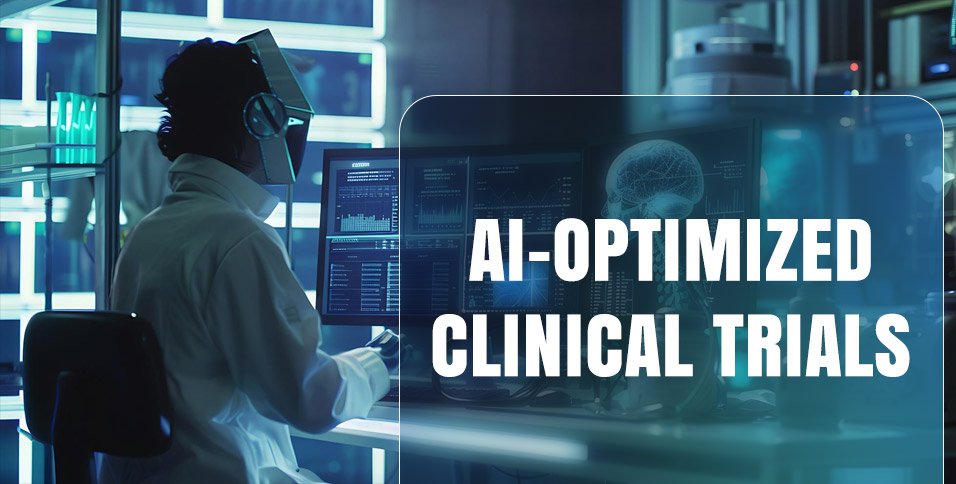
The modern pharmaceutical industry is rising with the new trends. With huge money being spend on pharmaceutical industry, there are different experiments made with AI and Generative AI. For well being of the patients, these clinical reports play an important role.
The need of patient engagement, compliance with stringent regulations makes clinical trial an indispensable but costly step in the medical innovation. The average trial costs can reach billion of dollars and take span of years from the development to approval of particular drug. These trials ensure that treatments are meeting safety regulations and evaluations proving the best for the people of the industry so that they do not face any issues in long- term.
Complex regulations are turning into simplified process through Artificial Intelligence. Many doctors and pharmaceutical industries are using best softwares and tools to accelerate the quest for the research. AI is a complete game changer for the clinical trials. Let’s see how
How AI has changed the world of clinical trials?
- Adopting to the patterns and trends: There are wide range of companies and pharamaceutical firms which are leveraging AI for new trends. These trends are covering up the traditional methods used for monitoring and giving real time analysis for the problem to solve things at ease.
- Great patient experience and feedback: In clinical and healthcare industry, AI can be a game changed to improve the overall patient experience. AI based analysis can help to monitor the condition of the patients, which can help doctors to diagnose issue in more reliable manner.
- Drug Development: From clinical studies to testing drug for a particular disease and optimizing the best output. Advanced AI is analysing the process of drug development which is helping to make tasks easier, as scientists do not need to depend time on irrelevant kind of things.
Main Role of Artificial Intelligence in Clinical Trials
Let us explore how specific AI technologies are revolutionizing the clinical and healthcare industries:
- Multi-agent systems (MAS): In clinical Trials, Multi Agent systems are used to coordinated the tasks. They are used to monitor the patient cohorts, detecting anomalies and helping in efficient management.
- Graph Neural Networks: For complex relationships and data such as drug interactions, patient similarities these GHHs are helping to predict the treatment and providing a comprehensive view of the trial data.
- Natural Language Processing: From extracting patient records to streamlining the data process. NLP are used to reduce the time needed for protocol development and documentation. NLP also help in analysing the adverse event reports which are important for patient’s safety.
- Reinforcement Learning: RL can help in trial designs and can also help in optimizing patient outcomes, reducing unnecessary interventions and adapting to the safety trends. To focus on individual patient’s data, RL help in personalized approaches within the treatment that further helps in simplifying the process.
Advantages of AI in Clinical Trials:
Drug development and creating new medicines often costs a huge ton of money. AI and Machine learning can help in supporting the growth of new drug development. Here is how AI helping in clinical trials.
- Cost Reduction: Reduction in costs with the help of AI and certain predictive analysis. With the experimentation of new trials, Generative AI and AI can help in searching for new drug compounds.
- Customized Medicine Development: Based on variables such as lifestyle and genetics, AI can help in medicine development and help in the personalization of different medicines.
- Improved Data Analysis: Change in the volumes of data can be predicted by AI in very easy manner which helps in avoiding the wastage of time and resources. It can be also used to forecast the toxicity of any particular material.
Conclusion
Artificial Intelligence is growing in clinical industry and experts are using different kind of approaches to implement use of certain tools in the clinical industry. With the technology and generative AI, clinical departments are making maximum use to accelerate the development of new therapies and treatments.
The pharma industry is growing and generative AI used in patient recruitment to data management is worth taking the risk. It has paved to the path of more success in the healthcare industry. Benefits of AI cannot be ignored as in future it will become standard tool for clinical practice.
FAQ
What are the challenges faced using AI in clinical trials?
One of the major challenges are data security and privacy and integration AI tools with the existing systems.
What are the advantages of using AI in clinical trials?
One of the major advantages of using AI in clinical trials are real- time monitoring, automating data collection and integration of data from various resources which leads to better efficiency and accuracy.
Can we design clinical trial protocols through AI?
Yes we can do by optimizing designs and recommending improvements in the certain areas.