GLP-1 has become one of the most widely discussed terms in American healthcare. Medications such as Ozempic and Wegovy have brought attention to a class of drugs that was initially best known for helping people with type 2 diabetes but is now playing a much broader role in metabolic health.
Despite the attention, there is still considerable confusion about what GLP-1 actually is.
GLP-1 is a hormone that the body produces naturally. GLP-1 receptor agonists are medications that work in a similar way to this hormone.
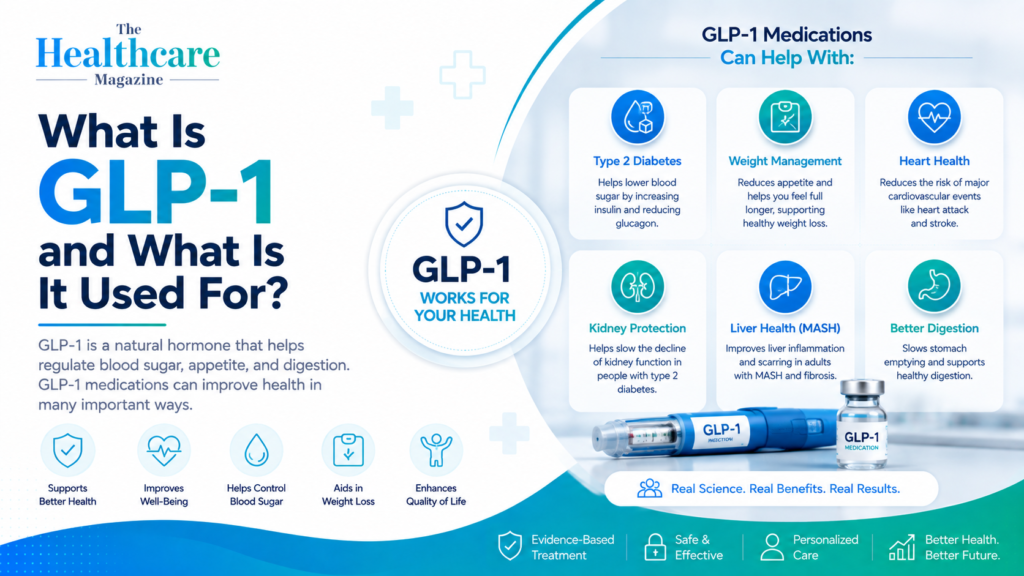
These medicines can influence blood sugar, appetite, digestion, and body weight. Certain GLP-1 medications also have FDA-approved uses related to cardiovascular disease, chronic kidney disease, and liver disease in specific patient populations.
Understanding how GLP-1 works can make it easier to separate the medical facts from the considerable publicity surrounding these treatments.
What Does GLP-1 Mean?
GLP-1 stands for glucagon-like peptide-1.
It is a hormone produced primarily in the gut and released in response to eating. GLP-1 is part of the body’s natural system for managing blood glucose and responding to food.
After you eat, GLP-1 helps the pancreas release insulin to control blood sugar. It also lowers the amount of glucagon, a hormone that raises blood sugar.
GLP-1 has effects beyond the pancreas.
It can temporarily slow the movement of food from the stomach into the small intestine and influence signals involved in appetite and fullness. Together, these effects help explain why the GLP-1 pathway has become an important target for treating metabolic conditions.
The body’s natural GLP-1 does not remain active for very long. Researchers therefore developed medications that act on the same receptor but remain effective for much longer.
These medicines are called GLP-1 receptor agonists.
How Do GLP-1 Medications Work?
GLP-1 receptor agonists are medications that work like the natural GLP-1 hormone in the body.
Their effects generally involve several processes.
First, they can increase insulin release when blood glucose is elevated. Insulin helps move glucose from the bloodstream into cells, where it can be used for energy.
Second, GLP-1 medicines can reduce glucagon secretion when appropriate. Because glucagon encourages the liver to release glucose, reducing its activity can help improve blood sugar control.
Third, these medications can slow gastric emptying. Food may leave the stomach more slowly, which can influence the rise in blood glucose after eating.
Finally, GLP-1 receptor activation can affect appetite and feelings of fullness. This may help some patients eat less and lose weight.
These combined effects explain why the medications can be useful for both blood glucose management and chronic weight management.
However, individual results vary, and the exact benefits depend on the specific medication, dose, medical condition, and patient.
What Are GLP-1 Medications Used For?
GLP-1 drugs are sometimes discussed as though they all have the same purpose. They do not.
FDA-approved indications differ between medications and even between products containing the same active ingredient.
A medication approved to treat type 2 diabetes should not automatically be considered approved for chronic weight management simply because weight loss can occur during treatment.
In the United States, major uses of GLP-1-based therapies include the following.
1. Type 2 Diabetes
Type 2 diabetes was one of the first major areas in which GLP-1 receptor agonists became widely used.
People with type 2 diabetes may have difficulty producing enough insulin or using insulin effectively. As a result, glucose can remain elevated in the bloodstream.
GLP-1 receptor agonists can help control blood sugar by increasing insulin levels when needed and reducing the amount of sugar released by the liver.
Several GLP-1 medications have been approved in the U.S. for type 2 diabetes.
One well-known example is Ozempic (semaglutide), which is FDA-approved, along with diet and exercise, to improve blood glucose control in adults with type 2 diabetes. Its approved indications also extend to certain cardiovascular and kidney outcomes in defined groups of adults with type 2 diabetes.
Importantly, these medications are not substitutes for individualized diabetes management. Diet, physical activity, blood glucose monitoring, and other medications may remain part of a patient’s treatment plan.
2. Chronic Weight Management
GLP-1 medications have attracted particularly strong attention because of their ability to help some people lose substantial amounts of weight.
The effect is not simply caused by food remaining in the stomach longer.
GLP-1 receptors are involved in appetite regulation, and medications acting on this pathway can help reduce hunger and increase feelings of fullness. For some patients, this makes maintaining a lower calorie intake more manageable.
Wegovy (semaglutide) is a GLP-1 medication approved for long-term weight management in certain adults and adolescents. It is used along with a healthy diet and regular physical activity. In March 2026, the FDA also approved a higher-dose Wegovy injection for weight loss and long-term weight maintenance in certain adults.
Eligibility for prescription weight-management treatment depends on factors such as body mass index, age, weight-related health conditions, and the specific medication.
These drugs are intended as medical treatments for appropriate patients rather than simply cosmetic solutions for losing a few pounds.
Ozempic and Wegovy Are Not the Same Prescription
One source of confusion is that both Ozempic and Wegovy contain semaglutide.
That does not make the products interchangeable.
They have different FDA-approved indications, dosing considerations, and prescribing information.
Ozempic is mainly used to treat type 2 diabetes. For certain patients, it can also help reduce the risk of heart and kidney complications.
Wegovy is approved for chronic weight management in eligible patients and has other specific indications.
Using the brand name and indication correctly is particularly important when discussing these medications because saying that “Ozempic is a weight-loss drug” oversimplifies its FDA-approved role.
Healthcare professionals determine which treatment is appropriate based on the individual patient’s medical situation.
3. Reducing Cardiovascular Risk
The GLP-1 story has expanded beyond diabetes and weight loss.
In 2024, the FDA approved Wegovy to reduce the risk of cardiovascular death, heart attack, and stroke in adults who have cardiovascular disease and either obesity or overweight.
The decision was supported by a large clinical trial involving more than 17,600 participants. Major cardiovascular events occurred in 6.5% of participants receiving Wegovy compared with 8% receiving placebo.
This was an important development because it demonstrated that a GLP-1 medication could provide benefits extending beyond changes on the scale.
Cardiovascular disease remains a major concern for people with obesity, overweight, and type 2 diabetes. For eligible patients, certain GLP-1 treatments may therefore form part of a broader strategy to reduce health risks.
4. Chronic Kidney Disease in Certain Patients
Kidney health is another area in which the role of GLP-1 therapy has expanded.
The FDA approved an additional indication for Ozempic to reduce the risk of sustained decline in kidney function, end-stage kidney disease, and cardiovascular death in adults who have both type 2 diabetes and chronic kidney disease.
In the FLOW trial, which included 3,533 adults with type 2 diabetes and chronic kidney disease, semaglutide reduced the incidence of the study’s primary composite kidney and cardiovascular endpoint compared with placebo.
This does not mean that GLP-1 medicines are general treatments for everyone with kidney disease.
The indication applies to a defined patient population, which is why individual medical assessment remains important.
5. MASH and Liver Health
The medical uses of GLP-1 therapy have continued to develop.
In August 2025, the FDA approved Wegovy for adults with metabolic dysfunction-associated steatohepatitis (MASH) and moderate-to-advanced liver fibrosis.
MASH is a serious form of metabolic liver disease in which excess fat in the liver is associated with inflammation and scarring.
In a clinical study, 63% of patients taking Wegovy showed improvement in MASH without worsening liver scarring, compared with 34% of patients who received a placebo. Improvement in fibrosis without worsening of MASH occurred in 37% and 22%, respectively.
The MASH indication received accelerated approval, meaning additional evidence is required to confirm long-term clinical benefit.
This development further demonstrates how GLP-1-based therapy is expanding into areas connected with metabolic health.
Are All GLP-1 Drugs the Same?
No.
Although medications within this category affect the GLP-1 pathway, they can differ in their active ingredients, approved uses, dosing schedules, delivery methods, and clinical effects.
Some medications work only on GLP-1, while others work on GLP-1 and other hormones in the body.
For example, tirzepatide acts on both GIP and GLP-1 receptors, which means it is not technically a GLP-1-only receptor agonist.
These distinctions are important because medications that are often grouped together in everyday conversation are not necessarily identical in how they work.
Patients should therefore compare specific medications rather than assuming every “GLP-1 drug” provides the same benefits or carries exactly the same risks.
What Are the Common Side Effects?
Gastrointestinal side effects are common with GLP-1 receptor agonists.
Depending on the medication, these may include:
- Nausea
- Vomiting
- Diarrhea
- Constipation
- Abdominal discomfort
- Indigestion
- Bloating
Symptoms can sometimes be more noticeable when treatment begins or when the dose increases.
There are also potentially serious risks that vary according to the medication and the patient’s medical history.
For example, current Wegovy prescribing information includes warnings involving pancreatitis, gallbladder disease, hypoglycemia in certain circumstances, kidney injury, hypersensitivity reactions, and diabetic retinopathy complications in people with type 2 diabetes.
GLP-1 medications should therefore be used under appropriate medical supervision.
What About the Thyroid Cancer Warning?
Patients may have questions when they first see this warning in the medication information.
Semaglutide products carry a boxed warning regarding thyroid C-cell tumors. The warning is based on findings in rodents, and it is not known whether these medications cause thyroid C-cell tumors, including medullary thyroid carcinoma, in humans.
Wegovy should not be used by people with a personal or family history of medullary thyroid carcinoma (MTC) or those with Multiple Endocrine Neoplasia syndrome type 2 (MEN 2).
Patients should discuss their personal and family medical histories with a healthcare professional before starting treatment.
Can Someone Without Diabetes Use a GLP-1 Medication?
Yes, depending on the specific medication and the reason it is prescribed.
A person does not necessarily need to have type 2 diabetes to qualify for an FDA-approved GLP-1 treatment.
For example, Wegovy has approved uses for chronic weight management in certain people without diabetes and for reducing major cardiovascular risks in eligible adults with cardiovascular disease and obesity or overweight.
The important question is not simply whether someone has diabetes. It is whether they meet the medical criteria for the particular medication and indication.
Why Medical Supervision Matters
The popularity of GLP-1 medications has created a large market for online weight-loss services and products advertised as alternatives to FDA-approved medicines.
Patients should be careful.
Semaglutide is a prescription medication in the United States, and the FDA has taken action against businesses making misleading claims about unapproved semaglutide products.
A healthcare professional can make sure the treatment is suitable for you and monitor how well it is working.
Medical supervision also provides an opportunity to address nutrition, physical activity, other health conditions, and potential side effects rather than treating GLP-1 therapy as an isolated solution.
Are GLP-1 Medications a Permanent Solution?
GLP-1 medicines should not be viewed as a quick fix.
Conditions such as type 2 diabetes and obesity are chronic diseases that often require long-term management.
Treatment decisions may change over time depending on effectiveness, side effects, medical conditions, access, insurance coverage, and individual goals.
Some patients may regain weight or experience changes in blood glucose after stopping treatment. For this reason, starting or discontinuing a GLP-1 medication should be discussed with the prescribing healthcare professional rather than managed independently.
Long-term care may also include a healthy diet, regular exercise, good sleep, and other medications when needed.
The Future of GLP-1 Treatment
GLP-1 therapy has moved far beyond its original role in diabetes management.
Researchers and healthcare organizations continue to investigate how the GLP-1 pathway and related metabolic pathways may affect cardiovascular disease, kidney disease, liver disease, obesity, and other conditions.
At the same time, the expanding list of approved indications shows why it is increasingly inaccurate to describe GLP-1 medicines simply as “weight-loss injections.”
They are becoming part of a broader approach to metabolic medicine.
Future research will help determine which patients benefit most, how treatments can be used safely over longer periods, and whether additional medical indications are appropriate.
Final Thoughts
GLP-1 is a naturally occurring hormone involved in blood glucose regulation, digestion, and appetite. GLP-1 receptor agonists are medications that act like the natural GLP-1 hormone but remain active in the body for longer.
In the United States, these medications are commonly used to treat type 2 diabetes and help with long-term weight management. Specific medications also have FDA-approved uses related to cardiovascular risk, chronic kidney disease, and MASH in defined patient populations.
Their growing popularity should not obscure an important point: GLP-1 medications are prescription treatments, not universal solutions.
The right drug, dose, and treatment plan depend on the individual.
For patients considering GLP-1 therapy, understanding what the medication is approved to treat and discussing its potential benefits and risks with a qualified healthcare professional is more useful than relying on social media trends or the popularity of a particular brand name.