Artificial intelligence is becoming part of many areas of healthcare in the United States. It is used in hospitals, clinics, imaging centers, laboratories, and even some home health tools. One important area is AI-enabled medical devices.
These devices can help doctors detect disease, review medical images, monitor patients, and support clinical decisions. They can make healthcare faster and more precise when used correctly. But they also come with risks that patients, providers, and healthcare leaders need to understand.
AI in healthcare should not be viewed as magic. Like any medical tool, it must be tested, monitored, and used with care.
What Is an AI-Enabled Medical Device?
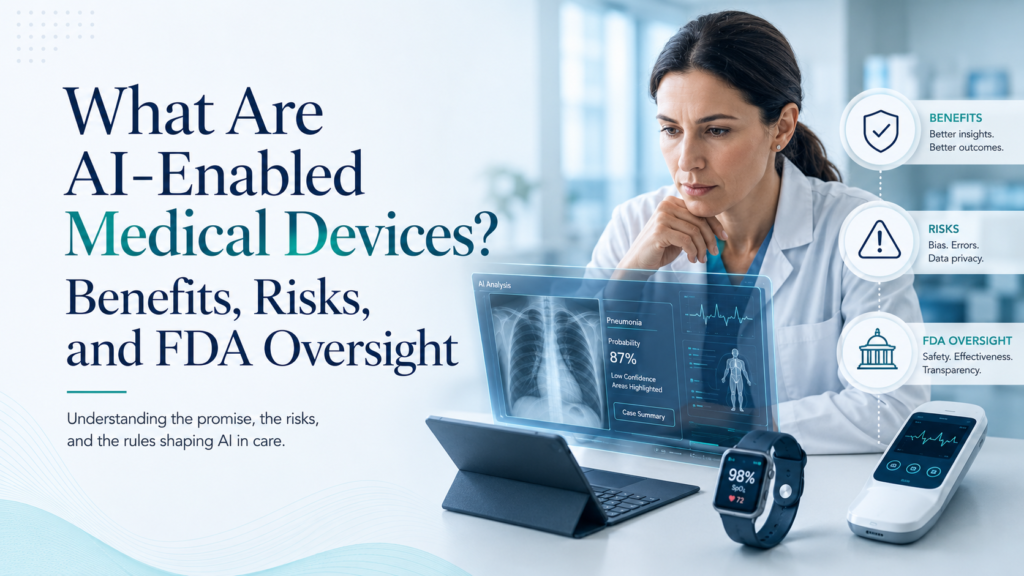
An AI-enabled medical device is a medical device that uses artificial intelligence or machine learning to perform a healthcare-related task.
Some of these devices are physical tools. Others are software programs used with existing medical systems. For example, an AI tool may help read an X-ray, detect an abnormal heart rhythm, analyze a skin image, or alert a care team when a patient may be at risk.
The device does not replace a doctor or nurse. In most cases, it supports their work by helping them review information and notice patterns that may be difficult to detect manually.
AI-enabled devices are often used in areas such as radiology, cardiology, pathology, surgery, patient monitoring, and diagnostics.
How Do These Devices Work?
AI-enabled medical devices use data to learn patterns. The data may come from medical images, test results, waveforms, patient records, or sensor readings.
For example, an AI tool used in radiology may be trained on medical images. Over time, the system learns to identify patterns that may suggest a fracture, tumor, bleeding, or another concern.
When a new image is entered, the tool compares it with what it has learned and provides an output. That output may be a risk score, an alert, a measurement, or a suggested finding.
The healthcare professional still needs to review the result and apply clinical judgment. AI can support decisions, but it should not be treated as the only decision-maker.
Benefits of AI-Enabled Medical Devices
One major benefit of AI-enabled medical devices is speed. In busy healthcare settings, doctors and technicians may need to review large amounts of information. AI can help organize data and highlight cases that need attention.
This can be especially useful in medical imaging. An AI tool may help flag urgent findings so that a radiologist can review them sooner. This does not mean the AI gives the final answer. It means the tool can help prioritize care.
Another benefit is consistency. Human review can be affected by fatigue, workload, or time pressure. AI tools can apply the same method each time they review data. This may help reduce variation in certain tasks.
AI-enabled devices may also improve access to care. In some areas, there may be a shortage of specialists. AI tools can support clinicians by helping them screen, monitor, or review cases more efficiently.
For patients, these benefits may lead to faster results, earlier detection, and better follow-up. When used well, AI can help make care more timely and organized.
Risks Patients and Providers Should Understand
AI-enabled medical devices also carry risks. One risk is inaccurate results. The device may miss a problem, flag something that is not serious, or provide an output that does not fit the patient’s full condition.
This can happen for many reasons. The tool may not have been trained on enough diverse data. It may perform better for some patient groups than others. It may also struggle when used in a setting that is different from the one it was designed for.
Another risk is overreliance. If healthcare teams trust AI too much, they may miss signs that the tool is wrong. AI should support clinical thinking, not replace it.
There are also privacy and cybersecurity concerns. AI-enabled devices may use sensitive health data. This data must be protected from misuse, errors, and unauthorized access.
Bias is another concern. If the data used to train an AI system does not represent the wider U.S. population, the device may not perform equally well for everyone. This matters because healthcare decisions should be safe and fair for patients across different ages, races, genders, and health backgrounds.
Why Human Oversight Still Matters
AI can process data quickly, but it does not understand patients the way healthcare professionals do.
A doctor or nurse considers symptoms, medical history, family concerns, physical exams, test results, and patient preferences. AI looks at a specific type of data for a specific task.
That is why human oversight is essential. Healthcare professionals must understand what the AI tool is designed to do, its limits, and when to question the result.
Patients should also feel comfortable asking questions. If an AI-enabled device is part of their care, they can ask how it is being used and whether a clinician will review the result.
FDA Oversight of AI-Enabled Medical Devices
In the United States, the Food and Drug Administration regulates medical devices, including many AI-enabled medical devices. The FDA reviews devices based on their intended use, level of risk, and safety and effectiveness data.
The FDA also provides a public list of AI-enabled medical devices approved for marketing in the United States. This list helps patients, providers, developers, and healthcare organizations understand which AI-enabled devices have gone through FDA review.
AI creates a special challenge because some systems can change or improve over time. Traditional medical devices are often more fixed. AI software may need updates as new data becomes available or as developers improve the system.
Because of these concerns, the FDA has been developing guidance for software used in AI-enabled medical devices. This includes how companies should manage changes, validate performance, and monitor safety throughout the device’s life cycle.
What Healthcare Organizations Should Consider
Before adopting an AI-enabled medical device, healthcare organizations should look beyond the product demo.
They should ask whether the device solves a real clinical problem. They should review how it was tested, which patient groups were included, and how results will be monitored after use.
They should also train staff properly. A good tool can fail if users do not understand it. Training should explain how the device works, when to use it, and what to do when the output seems unclear.
Organizations should also have a plan for patient communication. Patients do not need technical details, but they deserve clear information when AI plays a role in their care.
The Future of AI-Enabled Medical Devices
AI-enabled medical devices will likely become more common in the U.S. healthcare system. They may help improve diagnosis, reduce delays, support remote monitoring, and make clinical workflows more efficient.
But success will depend on trust. Patients and providers need to know that these tools are safe, fair, and useful.
AI should not make healthcare feel less human. The best AI-enabled devices will support clinicians, protect patients, and improve care without adding confusion.
Conclusion
AI-enabled medical devices are changing how healthcare teams detect, monitor, and manage health conditions. They offer important benefits, including faster review, better support for clinical decisions, and improved workflow efficiency.
At the same time, they carry risks related to accuracy, bias, privacy, and overreliance.
That is why FDA oversight, strong testing, staff training, and human judgment are so important. AI can be a powerful part of modern healthcare, but it must be used responsibly.
For patients, the key message is simple: AI may support your care, but it should not replace the knowledge, judgment, and compassion of your healthcare team.