Artificial intelligence is becoming a practical part of healthcare administration in the United States. While much of the attention around healthcare AI has focused on diagnosis, medical imaging, drug development, and clinical decision-making, some of its most immediate effects are happening behind the scenes.
Medical billing and coding are among the areas experiencing significant change.
Healthcare organizations deal with large volumes of clinical documentation, insurance requirements, billing codes, claim submissions, denials, and payment follow-ups every day. These processes are essential, but they can also be time-consuming and vulnerable to human error.
AI is helping healthcare organizations automate parts of this work, identify potential issues earlier, and give billing and coding professionals better tools to manage increasingly complex workflows.
However, AI does not eliminate the need for experienced medical coders and billing professionals. Instead, it is changing how they work and where their expertise is most valuable.
Why Medical Billing and Coding Are Complex in the United States
Medical billing in the U.S. involves much more than sending an invoice after a patient receives care.
Healthcare providers must document services correctly, translate clinical information into appropriate codes, verify insurance requirements, submit claims, respond to payer requests, manage denials, and follow up on unpaid balances.
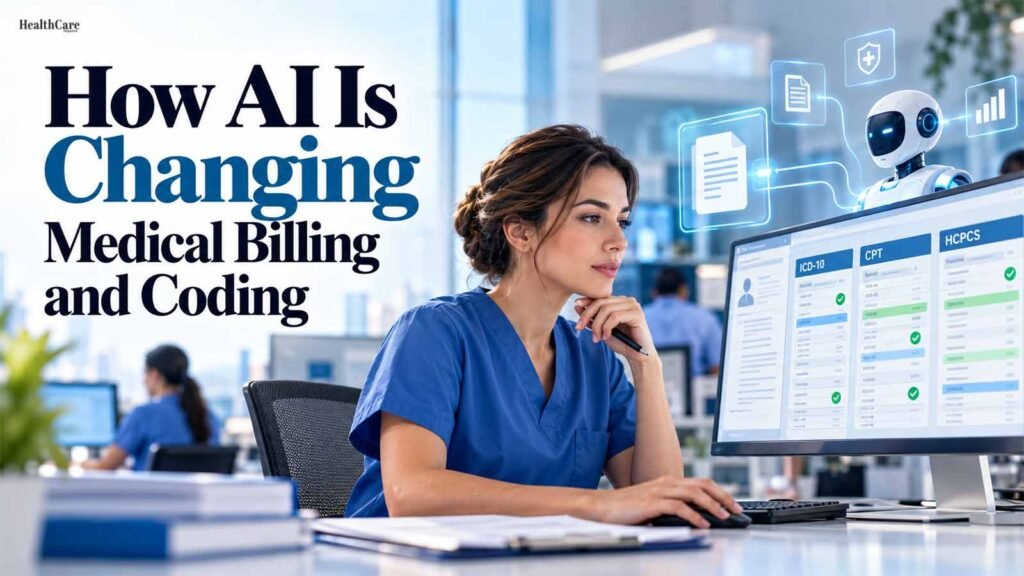
Coders may work with several coding systems, including ICD-10-CM, CPT, and HCPCS, depending on the type of diagnosis, service, procedure, or item being reported.
These systems also change over time. For example, the 2026 CPT code set introduced 288 new codes, along with 84 deletions and 46 revisions.
Keeping up with those changes while processing a large number of medical records requires considerable attention.
This is one reason AI-assisted technology has become increasingly relevant to revenue cycle management.
1. AI Can Review Clinical Documentation Faster
Traditionally, medical coders review physician notes, procedure reports, discharge summaries, test results, and other documentation before assigning codes.
AI-powered coding tools can help analyze this information.
Software powered by technologies (natural language processing (NLP)) can scan a medical record, pick out key clinical terms, and match them to possible diagnoses or procedure codes.
For example, a system may recognize information about a diagnosis, treatment, procedure, or anatomical location and suggest codes for a coder to review.
This does not necessarily mean that a code should be accepted automatically. Clinical documentation can contain uncertainty, conflicting information, abbreviations, or details that require professional judgment.
The value of AI is that it can complete some of the initial analysis quickly, allowing human coders to spend more time reviewing complicated cases and validating the final coding.
2. Automated Coding Is Becoming More Practical
Computer-assisted coding is not entirely new. What is changing is the sophistication of the technology behind it.
Earlier systems often relied heavily on structured rules and keyword matching. Modern platforms can use NLP, machine learning, and increasingly advanced language technologies to interpret unstructured clinical documentation.
According to AHIMA, automated coding tends to work well in areas where documentation follows fairly consistent patterns. More complex cases (like inpatient stays and surgical procedures) often still require greater human involvement. Qualified coding professionals also remain important for evaluating and validating coded information.
This creates a hybrid model.
Instead of asking whether coding will be performed by a person or a machine, healthcare organizations are increasingly determining which cases can be supported by automation and which require deeper professional review.
3. AI Can Help Detect Coding Errors Before Claims Are Submitted
A small coding or documentation error can have consequences later in the revenue cycle.
A claim may be delayed, rejected, denied, or returned for additional information. Staff then have to investigate the problem, make corrections, and resubmit the claim.
AI-powered systems can help perform checks earlier.
Depending on the technology, the software can find missing information, coding errors, or other issues that need further review.
Consider a claim in which the documentation does not clearly support the code selected. Instead of discovering the problem after the payer reviews the claim, an AI-assisted system may identify the inconsistency before submission.
The billing or coding team can then review the record.
Preventing avoidable errors before a claim leaves the organization can be more efficient than correcting them later.
4. Denial Management Is Becoming More Data-Driven
Claim denials are another area where AI can make a meaningful difference.
Healthcare organizations may receive denials for many reasons, including missing information, eligibility problems, coding issues, authorization requirements, documentation gaps, or payer-specific rules.
When thousands of claims are involved, finding patterns manually can be difficult.
AI and machine learning systems can analyze historical claims and denial data to identify recurring issues. For example, some claims may be denied because required documents are missing. AI can identify these patterns and help billing teams address the issue before submitting future claims.
That information can help revenue cycle teams address the problem before future claims are submitted.
Some systems can also help prioritize denied claims based on factors such as potential reimbursement, reason for denial, filing deadlines, or likelihood of successful resolution.
This allows staff to focus their attention where it may have the greatest impact.
5. AI Is Supporting Better Documentation
Accurate coding begins with accurate clinical documentation.
If a physician’s documentation is incomplete or unclear, even an experienced coder may not have enough information to select the appropriate code.
AI-powered clinical documentation improvement tools can review records and identify areas that may require clarification.
For example, software may recognize that a diagnosis appears in the record but lacks sufficient specificity for coding purposes. It can then flag the documentation for appropriate review.
There are important compliance considerations here. Technology-generated documentation queries still need to follow established standards and organizational policies. AHIMA and ACDIS guidance emphasizes that technology does not remove the need for compliant clinical documentation practices.
AI should therefore support better documentation rather than encourage documentation designed to produce reimbursement.
6. Prior Authorization Is Becoming More Digital
Medical billing does not begin after treatment. In many situations, administrative work starts before a service is provided.
Prior authorization is a major example.
CMS has been working to expand electronic prior authorization and reduce reliance on manual, portal-based, and fax-based processes. Certain CMS-regulated payers are required to implement specific prior authorization APIs beginning January 1, 2027.
AI may complement this broader shift toward digital workflows.
Technology can potentially help administrative teams identify authorization requirements, gather supporting documentation, monitor requests, and recognize missing information before submission.
CMS is also testing the use of enhanced technologies, including AI and machine learning, within the Wasteful and Inappropriate Service Reduction (WISeR) Model. The model combines technology with human clinical review for selected Medicare services.
These developments show that automation is affecting both provider and payer workflows.
7. AI Can Improve Revenue Cycle Analytics
Healthcare organizations generate enormous amounts of financial and operational data.
AI can help turn that information into useful insights.
Instead of looking only at reports showing what has already happened, organizations can use predictive analytics to identify potential problems earlier.
For example, AI can help billing teams identify claims that may be denied, find missing documentation, track accounts that need follow-up, and detect issues that could delay payment.
This can help revenue cycle leaders move from reactive problem-solving toward more proactive management.
For hospitals and large physician groups processing substantial claim volumes, even small improvements in accuracy or workflow efficiency can have a meaningful operational impact.
Will AI Replace Medical Coders?
The growing capabilities of AI naturally raise concerns about the future of medical coding jobs.
The more likely change is a shift in responsibilities rather than the complete disappearance of the profession.
Routine and predictable coding tasks may become increasingly automated. At the same time, healthcare organizations will continue to encounter complex cases involving ambiguous documentation, unusual procedures, payer requirements, compliance questions, audits, and clinical circumstances that require professional judgment.
Human oversight is particularly important when an automated recommendation could affect reimbursement or the accuracy of the patient’s medical record.
Medical coders may therefore spend less time manually searching for straightforward codes and more time validating AI-generated suggestions, reviewing complicated cases, handling exceptions, supporting audits, and monitoring coding quality.
The profession may become more technology-assisted, but human expertise remains important.
AI Creates New Compliance and Accuracy Risks
AI can improve efficiency, but it can also introduce new problems.
An AI system can make an incorrect recommendation. It may misunderstand clinical context, rely on incomplete documentation, or generate a code that appears reasonable but is not adequately supported by the patient’s record.
Errors can become especially serious if organizations automatically accept large volumes of AI-generated recommendations without sufficient oversight.
There are also concerns involving patient privacy, data security, algorithmic bias, auditability, and accountability.
Healthcare organizations should know how an AI system reaches its recommendations, what data it uses, where human review occurs, and how errors are identified and corrected.
Organizations using CPT content in AI-enabled products must also consider licensing requirements. The AMA has clarified that the use of CPT content with AI is subject to its licensing terms and applicable approvals.
Adopting AI, therefore, requires more than purchasing software. It requires appropriate governance, compliance controls, staff training, and ongoing performance monitoring.
AI Is Also Influencing the Coding System Itself
Another interesting development is that AI is not only helping professionals assign medical codes. AI-enabled medical services are increasingly being represented within the coding system.
The AMA’s CPT Appendix S provides a framework for categorizing AI-enabled medical services as assistive, augmentative, or autonomous based on how the software contributes to clinical care. The framework was updated in 2026 as medical AI continued to evolve.
The 2026 CPT code set also includes new codes involving assistive and augmentative AI services.
This highlights a broader change in U.S. healthcare: AI is becoming part of both clinical care and the administrative infrastructure used to document and report that care.
What the Future of Medical Billing and Coding May Look Like
The future of medical billing is unlikely to be completely manual or completely automated.
It will probably involve people and technology working together.
AI can review large amounts of information, handle repetitive tasks, identify potential problems, and alert healthcare professionals when further review is needed. Experienced coders and billing specialists can provide context, judgment, compliance oversight, and final validation when necessary.
For healthcare organizations, the goal should not simply be to automate as much as possible.
The better goal is to use automation where it improves accuracy and efficiency without sacrificing compliance, transparency, or appropriate human review.
As coding systems, payer requirements, digital health services, and reimbursement models continue to evolve in the United States, the professionals who understand both healthcare rules and AI-assisted workflows are likely to become increasingly valuable.
Final Thoughts
AI is changing medical billing and coding by making many administrative processes faster and more data-driven. From reviewing clinical documentation and suggesting codes to detecting potential errors, analyzing denials, and supporting prior authorization workflows, the technology is becoming involved across the revenue cycle.
But automation does not remove the need for accuracy or accountability.
Medical billing and coding directly affect provider reimbursement, healthcare data, compliance, and the patient’s financial experience. That makes responsible human oversight essential.
The strongest future for AI in medical billing is not one where technology replaces every human decision. It is one where AI handles appropriate repetitive work while skilled professionals focus on complex cases, compliance, quality, and judgment.
For U.S. healthcare organizations, that combination could make medical billing and coding more efficient while preserving the expertise needed to keep the process accurate and trustworthy.