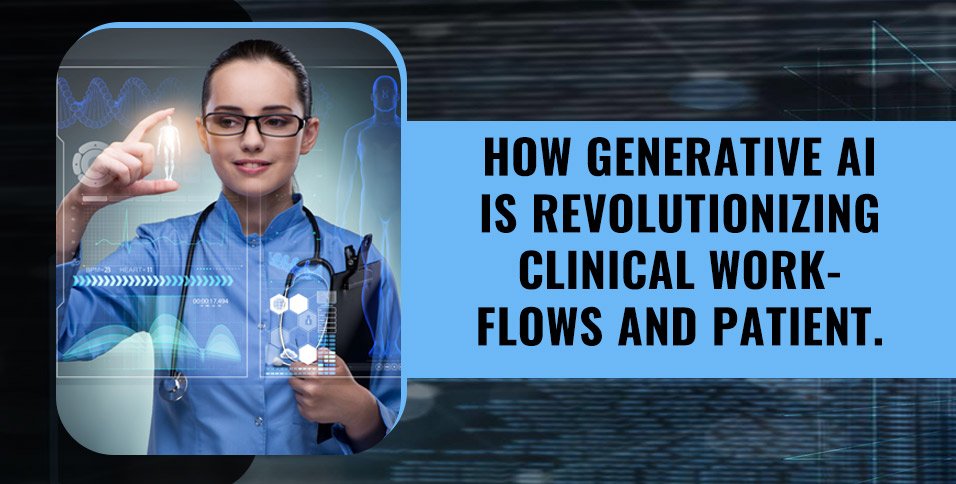
The world of healthcare is changing with the transformative AI helping in easier disease diagnosis and driving groundbreaking research, reshaping the healthcare industry. The technology not only ensures more personalized and satisfactory patient journey but also streamlines health operations, thereby providing more efficient, responsive and equitable healthcare environment.
In 2026, generative AI is expected to transform the healthcare market by making it more accessible, personalized and efficient. Generative AI development services are transforming healthcare with faster drug discovery and enhanced clinical workflows.
Responsible AI adoption is important to ensure the compliance with ethical, regulatory and technical standards along with addressing challenges of data privacy and bias. Let us know more about generative AI analysis.
What is generative AI in healthcare?
Generative AI in healthcare refers to the application of advanced artificial intelligence algorithms to create new synthetic data which works with the medical world. The technology is transforming the healthcare industry by automating routine administrative tasks and enhancing patient engagement.
Generative AI goes beyond analysing data and helps in assisting in disease diagnosis and patient outcome predictions, drug discovery and medical reporting helping in making healthcare more precise and efficient.
How does generative AI outcomes with clinical trials?
Generative AI enhances every stage with implementation and outcome assistant. Here are few examples:
- Post- Trial Analysis and Real World Evidence: Generative AI can link study results with the real world data such as claims and EHRs to assess long term effectiveness. Some natural language and signal detection models are able to accelerate pharmacovigilance timelines by scanning reports and literature for adverse event patterns.
- Ensuring Regulatory Compliance: Generative AI helps in regulating the workflows by automating document generation and certain privacy preserving methods help in enabling model training without exposing data of the patient, supporting GDPR and HIPAA compliance. However, it is important for sponsors to maintain human oversight through validation and clear documentation for regulators and ethics boards.
- Improving patient retention and compliance: Generative AI models help in detecting the early signs of disengagement and such kind of approaches with new technology can help in improving the patient experience.
- Advanced Data management and analysis: AI can help in automating ingestion, harmonization and machine learning also help in improving the endpoint sensitivity and subgroup discovery.
- AI powered patient recruitment and enrolment: Generative AI can help in improving clinical trial recruitment by scanning electronic health records, social and digital signals and by improving personalize messaging options for the organizations. AI usage may shorten enrolment windows, reduce screen failures and improve site used where algorithms are audited for bias and privacy is preserved.
What are the challenges for using AI for clinical trials?
AI has proven to be amazing for clinical trials but there are some major challenges and limitations which are as follows:
- AI clinical Trial Regulations: Regulatory expectations for AI transparency and validation are still evolving and differ from country to country, creating uncertainty for researchers.
- Privacy and Security Concerns: One of the major challenge is aggregating patient records, device streaks and genomic data makes systems attractive targets for data breaches. Poorly secured pipelines can violate GDPR and reduce patient confidence.
- Data quality, availability and standardization: AI needs large, consistent datasets but clinical data is usually recorded with different formats and missing key field which could be major challenge. Poor data reduces model performance and may require lot of human intervention.
- Technical Infrastructure and Integration: Generative AI workflows usually require secure data pipelines, EHR integration and standard APIs. Poor integration may often lead to manual workarounds, delayed insights and weak pilots which do not scale.
- Interpretability and Black Box Modeling: Different AI complex models can offer accurate predictions but may offer little insight, making clinicians and regulators uneasy about trusting or acting on the results.
Real World Examples of Generative AI:
Some of the real world examples where generative AI is being used are as follows:
- Medical Dialogue Generation: Generative AI can help in generating realistic medical conversations between healthcare patients and provides which can be used in assisting medical education, training chatbot systems and improving patient communication and engagement.
- Radiation Dose Optimization: Generative AI can optimize radiation therapy planning by generating alternative treatment plans which can help in maximizing treatment efficacy while minimizing radiation dose to healthy tissues.
- Data Imputation: Generative AI can impute missing or incomplete data in clinical research datasets. By learning patterns from existing data, generative models can help in generating plausible values to fill in missing information, improving the completeness and quality of dataset.
- Genomic Data Generation: Generative AI can help in generating synthetic genomic data which includes DNA sequences to augment existing datasets. This could help in studying complex genetic disorders, identifying biomarkers and designing precision medicine approaches.
- Disease Progression Modeling: Generative AI can help in simulating the progression of diseases. By generating synthetic patient data which mimics disease progression patterns, researchers can gain more insights into disease dynamics, predict disease outcomes and inform treatment strategies.
- Clinical Trial Simulation: Generative AI can simulate virtual patients and generate synthetic clinical trial data which helps researchers design and optimize clinical trials, explore different scenarios and estimate potential outcomes before conducting real trials.
- Patient Data Synthesis: Generative AI can generate synthetic patient data which resembles real world data preserving the privacy of the patient. This can be helpful in analysing sensitive healthcare data without revealing the identities of individuals.
- Data Augmentation: Generative data makes best use of augment clinical research datasets by generating additional synthetic data helping in overcoming limitations in sample size and increasing the diversity of data.
- Drug Discovery: Generative AI can aid in the discovery and design of new drugs by generating novel molecular structures with desired properties. It creates virtual compounds that could be screened for potential therapeutic applications, thereby saving time and resources in drug discovery process.
- Medical Image Generation: Generative AI can help in generating synthetic medical images such as MRI, CT scans and X-rays. These generated images can be used for training machine learning models. Augmenting limited datasets and developing new imaging techniques.
Conclusion
The application of generative artificial intelligence in clinical research has helped in various aspects of healthcare such as diagnosis, treatment planning and drug discovery. By using generative AI in healthcare organizations can improve efficiency and drive new innovations in the clinical research.
To support treatment planning and improving diagnosis accuracy, generative AI also helps in MRI scans, CT scans or histopathological slides which helps in anomaly detection. Furthermore, generative AI techniques helps in predicting outcomes and suggesting optimal treatment techniques leading to improved patient care and outcomes.