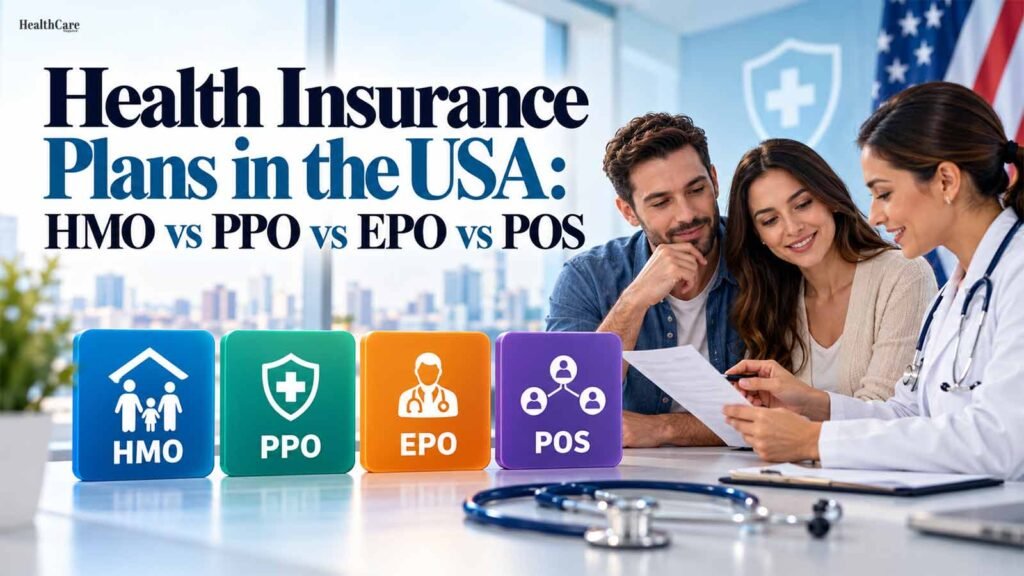
Choosing health insurance in the United States can feel complicated, especially when plans are described with acronyms such as HMO, PPO, EPO, and POS.
At first glance, these plans may appear similar. They all provide health insurance coverage and generally rely on networks of doctors, hospitals, laboratories, pharmacies, and other healthcare providers. However, each plan has its own rules for getting care.
Some plans give members considerable freedom to choose doctors and specialists. Others keep costs under control by requiring patients to stay within a defined provider network. Certain plans require referrals, while others allow patients to schedule specialist appointments directly.
Understanding these differences can make it easier to choose coverage that fits your healthcare needs, budget, and preferred doctors.
Here is a closer look at how HMO, PPO, EPO, and POS health insurance plans work in the United States.
First, What Is a Health Insurance Provider Network?
Before comparing these plans, it helps to know what a provider network is.
Health insurance companies contract with doctors, hospitals, clinics, laboratories, and other healthcare providers. These participating providers form the plan’s network.
Receiving care from an in-network provider generally costs less because the provider has agreed to negotiated rates with the insurer.
An out-of-network provider does not have the same contractual relationship with the health plan. Depending on your insurance, receiving non-emergency care outside the network may cost considerably more or may not be covered at all.
This distinction is one of the biggest differences among HMO, PPO, EPO, and POS plans.
HealthCare.gov notes that some Marketplace plans restrict provider choices, while others allow members to receive care outside their networks at a higher cost.
What Is an HMO Plan?
HMO stands for Health Maintenance Organization.
An HMO generally provides healthcare through a defined network of doctors, hospitals, and other providers. Members usually need to receive non-emergency care within that network for the plan to cover it.
Many HMO plans also require members to select a primary care provider (PCP).
Your PCP becomes the main point of contact for your healthcare. If you need to see a specialist, such as a cardiologist or dermatologist, you may need a referral from your primary care doctor first.
HealthCare.gov explains that HMOs generally do not cover out-of-network care except in emergencies and may require members to live or work within the plan’s service area.
Advantages of an HMO
One of the main attractions of an HMO is cost.
HMOs often offer relatively affordable premiums because care is managed through a defined network. They can work particularly well for individuals and families who already have access to suitable doctors and hospitals within the network.
Care coordination can also be useful. Because a primary care physician often oversees treatment and specialist referrals, patients may have a more structured healthcare experience.
Possible Drawbacks
The biggest limitation is flexibility.
If your doctor or hospital is not in the plan’s network, your insurance may not cover the full cost of your care.
Referral requirements can also add an extra step when specialist treatment is needed.
An HMO may therefore suit someone who values predictable, coordinated care and is comfortable using a specific network.
What Is a PPO Plan?
PPO stands for Preferred Provider Organization.
PPO plans are generally designed to provide more freedom when choosing healthcare providers.
Members pay less when they use doctors and hospitals within the PPO network. However, unlike an HMO or EPO, a PPO generally provides some coverage for out-of-network care as well.
That flexibility comes at a price.
Out-of-network services typically involve higher deductibles, coinsurance, or other costs. Patients may also face charges that would not apply when using contracted providers.
Another major difference is referrals.
PPO members generally do not need a referral from a primary care doctor before making an appointment with a specialist.
With a PPO plan, you usually pay less when you visit doctors and hospitals within the plan’s network. You can also receive care outside the network, but it usually costs more.
Advantages of a PPO
The biggest benefit is flexibility.
A PPO may be appealing if you regularly see specialists, want greater control over which doctors you visit, or need access to healthcare providers in different locations.
It can also be useful for people who want the option of seeing an out-of-network physician when necessary.
For example, someone receiving treatment for a complicated medical condition may want access to a particular specialist who is not available in every insurer’s network.
Possible Drawbacks
Greater flexibility can mean higher costs.
PPO premiums are often higher than those of more restrictive network plans. You may have to pay more if you receive care from a doctor or hospital outside the plan’s network.
A PPO, therefore, does not automatically mean cheaper healthcare simply because it gives you more choices.
The value depends on how frequently you use medical services and whether you actually need its broader provider access.
What Is an EPO Plan?
EPO stands for Exclusive Provider Organization.
An EPO can be thought of as combining certain characteristics commonly associated with HMOs and PPOs.
Like an HMO, an EPO generally requires members to receive non-emergency care within the plan’s provider network.
With an EPO plan, you generally need to use doctors, specialists, and hospitals within the plan’s network. Out-of-network care is usually not covered, except in emergencies.
However, EPO plans commonly allow patients to see specialists without first obtaining a referral from a primary care physician.
This allows members to see specialists directly without needing a referral from a primary care doctor.
Advantages of an EPO
An EPO may offer a useful balance for someone who does not want the referral requirements commonly associated with HMOs but is comfortable receiving care entirely within one provider network.
Being able to schedule an appointment with an in-network specialist directly can simplify care.
Possible Drawbacks
The network restriction is important.
If you voluntarily receive non-emergency treatment from an out-of-network provider, the plan generally will not cover the service.
Check if your doctors and hospitals are in the EPO network before you choose the plan.
What Is a POS Plan?
POS stands for Point of Service.
A POS plan combines characteristics of both HMO and PPO coverage.
Members typically receive the lowest costs when using providers within the plan’s network. At the same time, the plan may provide some coverage for healthcare received outside the network.
However, POS plans generally require members to work through a primary care physician and obtain referrals before seeing specialists.
With a POS plan, you usually pay less for in-network care. You may also need a referral from your primary care doctor before seeing a specialist.
Advantages of a POS Plan
A POS plan can provide more flexibility than an HMO because members may have access to some out-of-network benefits.
At the same time, the PCP-based structure can provide coordinated care.
A POS plan may be a good option if you want a primary care doctor to manage your care while still having access to out-of-network providers.
Possible Drawbacks
POS plans can involve more administrative steps.
You may need referrals for specialists, and receiving out-of-network treatment can result in substantially higher costs.
Out-of-network care may cost more, so check your plan’s coverage before visiting an out-of-network provider.
HMO vs PPO vs EPO vs POS: The Main Differences
The easiest way to compare these health insurance plans is to focus on two questions:
Can you receive covered care outside the network?
Do you generally need a referral to see a specialist?
In broad terms:
| Plan | Out-of-Network Coverage | Specialist Referral |
| HMO | Generally, no, except in emergencies | Often required |
| PPO | Generally, yes, but it costs more | Usually not required |
| EPO | Generally, no, except in emergencies | Usually not required |
| POS | Generally available at a higher cost | Usually required |
These are general characteristics rather than universal rules. Individual insurance policies can have different requirements, so members should always review the specific plan documents before making healthcare decisions.
What About Bronze, Silver, Gold, and Platinum Plans?
HMO, PPO, EPO, and POS should not be confused with the metal categories used in the Health Insurance Marketplace.
Marketplace plans can also be categorized as Bronze, Silver, Gold, or Platinum.
The metal category describes how healthcare costs are generally divided between the insurance company and the member. It does not indicate the quality of medical care.
A Bronze plan, for example, can be an HMO, while a Gold plan could also be an HMO. The same principle applies to PPOs, EPOs, and other available network structures.
HealthCare.gov specifically notes that metal categories relate to cost sharing rather than quality.
Understanding this distinction can prevent a common mistake when comparing Marketplace coverage.
How Should You Choose Between HMO, PPO, EPO, and POS?
There is no single health insurance plan type that is best for every American.
Instead of focusing only on the acronym, consider how you actually use healthcare.
Start with your doctors.
If you want to keep seeing your current doctors, check that they are included in the plan’s network. Next, consider how often you need specialist care.
Someone managing several chronic conditions may value the ability to see specialists directly. Another person may prefer having a primary care physician coordinate treatment.
Your location also matters.
People who frequently travel, live in more than one state, or have children attending college away from home may want to pay particular attention to how a plan handles non-emergency care outside its local network.
Prescription coverage should also be checked separately. Make sure medications you regularly take are included in the plan’s formulary and understand the applicable copays, coinsurance, and pharmacy network requirements.
Finally, look beyond the monthly premium.
Don’t Choose a Plan Based on Premium Alone
A low monthly premium can look attractive, but it represents only one part of healthcare spending.
You may also be responsible for:
- Deductibles
- Copayments
- Coinsurance
- Prescription drug costs
- Out-of-network expenses
- The annual out-of-pocket maximum
HealthCare.gov recommends considering both monthly premiums and the costs you may pay when receiving medical care.
For the 2026 plan year, the out-of-pocket limit for a Marketplace plan cannot exceed $10,600 for an individual or $21,200 for a family. However, premiums, non-covered services, and many out-of-network expenses do not count toward that limit.
Someone who expects frequent medical care may therefore find that a plan with a higher premium but lower cost sharing makes more financial sense than simply choosing the cheapest monthly option.
Do These Plans Cover the Same Essential Healthcare Services?
For plans sold through the Health Insurance Marketplace, all plan types must cover the Affordable Care Act’s essential health benefits.
These include areas such as emergency services, hospitalization, prescription drugs, maternity and newborn care, mental health and substance use disorder services, laboratory services, preventive care, and rehabilitative services.
Specific coverage details can still vary between plans and states.
The main difference between HMO, PPO, EPO, and POS plans is how you receive care and which doctors and hospitals you can use.
Final Thoughts
Understanding provider networks and referral rules can help you choose the right health insurance plan.
An HMO may be suitable for people who are comfortable with a defined network and coordinated care through a primary care physician.
A PPO provides greater provider flexibility and access to out-of-network care, generally in exchange for higher costs.
An EPO may appeal to people who want direct access to in-network specialists but do not need routine out-of-network coverage.
A POS plan allows your primary care doctor to coordinate your care and may also cover some out-of-network services.
The plan acronym, however, should never be the only factor in your decision.
Before enrolling, compare premiums, deductibles, copays, coinsurance, prescription coverage, provider networks, specialist access, and out-of-pocket limits. Most importantly, confirm that the doctors, hospitals, medications, and healthcare services you rely on are covered under the specific plan.
A health insurance plan that fits your real healthcare needs can be far more valuable than one that simply looks affordable on paper.